Medically Reviewed by Dr. Gnanaraj, BDS, MMC Chennai, PG Clinical Dentistry (Melbourne)
Principal Dentist, Denticare Dental & Implant Clinic
ASID Certified – Australian Society of Implant Dentistry
20+ years of clinical expertise in delivering advanced, patient-centered dental care
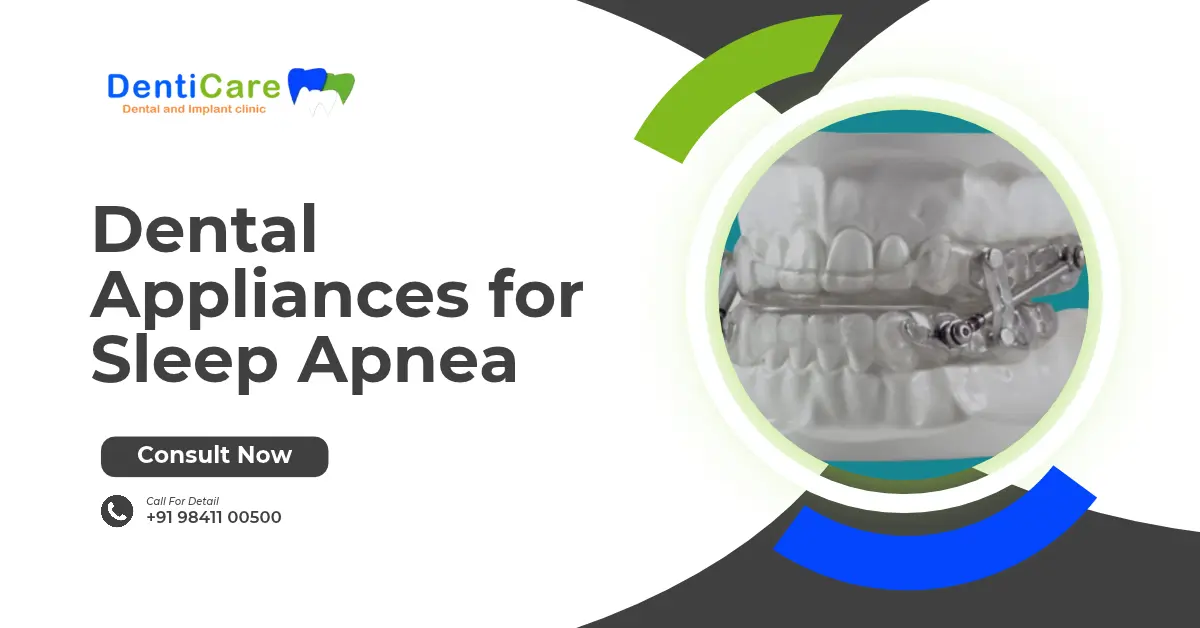
If you snore heavily, wake up gasping, or feel exhausted no matter how many hours you sleep, you might be dealing with obstructive sleep apnea (OSA). Many people are surprised to learn that a dentist — not just a sleep physician — can play a central role in treating it. Dental appliances for sleep apnea have become one of the most practical, well-tolerated options for people who can’t get comfortable with a CPAP machine.
This guide walks through how these devices work, who they suit, and what to expect if you’re considering one.
What is Sleep Apnea?
Obstructive sleep apnea occurs when the muscles at the back of the throat relax too much during sleep. The soft tissue collapses inward, narrows the airway, and briefly cuts off breathing — sometimes dozens or hundreds of times a night. Each pause ends with a gasp or snort as the brain jolts the body awake just enough to reopen the airway, though most people never remember it happening.
The result is fragmented, low-quality sleep. Left unmanaged, OSA has been linked to high blood pressure, heart problems, and persistent daytime fatigue, which is why getting a proper diagnosis matters before starting any treatment.
Signs You Might Need Sleep Apnea Treatment
Not everyone who snores has sleep apnea, but a few patterns are worth paying attention to:
- Loud, habitual snoring, often noticed by a partner before you notice it yourself
- Gasping, choking, or snorting sounds during sleep
- Waking up with a dry mouth or headache
- Feeling tired even after a full night’s sleep
- Difficulty concentrating or staying alert during the day
If several of these sound familiar, it’s worth asking your doctor about a sleep study rather than assuming an anti snoring dental appliance is the answer on its own — a proper diagnosis should always come first.
What Are Dental Appliances for Sleep Apnea?
A dental appliance — sometimes called oral appliance therapy — is a custom-fitted device worn in the mouth overnight. Instead of using air pressure like a CPAP machine, it works mechanically, holding the jaw or tongue in a position that keeps the airway from collapsing.
These devices are prescribed after a sleep study confirms an OSA diagnosis, and they’re fitted by a dentist trained in dental sleep medicine, usually working alongside a sleep physician.
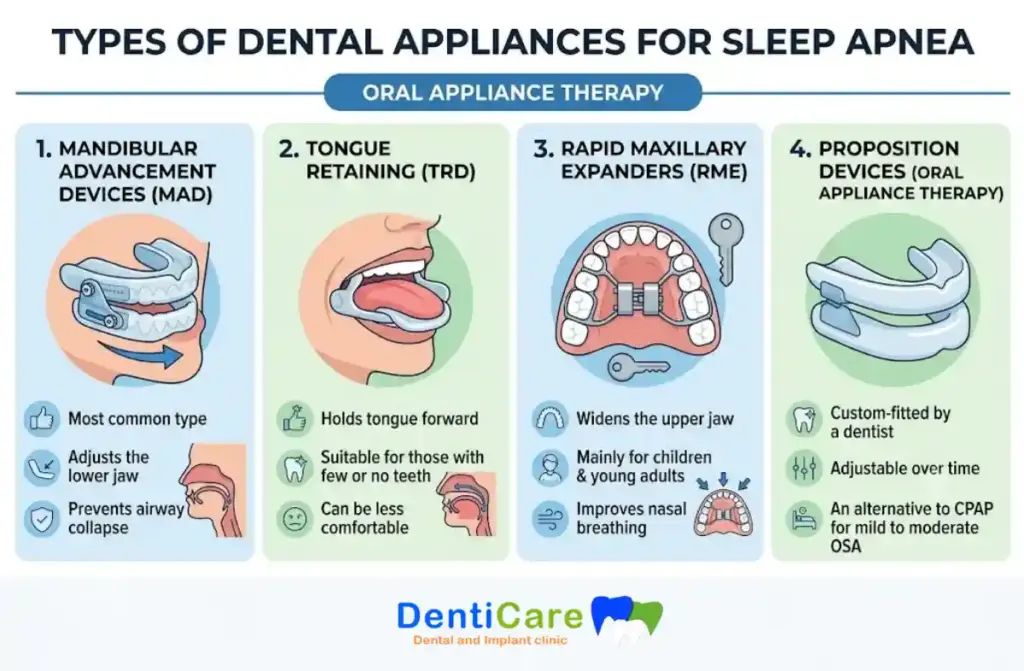
Types of Dental Appliances
Mandibular Advancement Devices (MADs)
The most widely used option, and often the first thing dentists recommend when discussing oral appliance therapy for sleep apnea. A mandibular advancement device for sleep apnea gently guides the lower jaw forward, which pulls the tongue and surrounding tissue away from the throat. Most versions are adjustable, so the dentist can fine-tune the position over several visits for the best result.
Tongue Retaining Devices (TRDs)
Rather than moving the jaw, a TRD uses gentle suction to hold the tongue forward, stopping it from falling back and blocking the airway. It’s a useful alternative for people who don’t respond well to jaw-repositioning devices.
Custom-Made vs. Over-the-Counter Options
A custom appliance is molded from impressions of your own teeth, giving a precise fit and room for adjustment. Boil-and-bite versions sold online are cheaper but generally less effective, less durable, and no substitute for a real diagnosis and professional fitting.
Who Benefits Most From These Devices?
Sleep apnea treatment with a dental appliance tends to work best for:
- Mild to moderate OSA
- Patients who can’t tolerate CPAP — because of mask discomfort, claustrophobia, or frequent travel
- Some cases of habitual snoring without a confirmed apnea diagnosis
They’re usually not the first choice for severe OSA, where CPAP remains more effective. A sleep physician’s evaluation is the right starting point to figure out which category you fall into.
If jaw clenching or teeth grinding is part of the picture, it’s also worth asking about bruxism management, since the two conditions sometimes overlap and can affect how an appliance is designed.
Dental Appliance vs. CPAP: How They Compare
| Factor | Dental Appliance | CPAP |
| Best suited for | Mild to moderate OSA | Moderate to severe OSA |
| Comfort | Generally well tolerated | Mask and airflow can feel intrusive |
| Portability | Small, no power required | Bulkier, needs electricity |
| Noise | Silent | Some machine sound |
| Long-term adherence | Often higher | Often lower, especially past the first year |
| Cost pattern | Mostly one-time | Ongoing (filters, masks, tubing) |
Neither option is universally “better” — the right choice depends on OSA severity, comfort, and which treatment you’ll actually stick with night after night.
What the Fitting Process Looks Like
- Diagnosis — A sleep study, done in a lab or at home, confirms OSA and how severe it is.
- Dental evaluation — A dentist checks your teeth, gums, jaw joints, and airway to see if you’re a good candidate.
- Impressions or digital scans — These capture the exact shape of your bite for a custom fit.
- Fabrication — The appliance is built, typically within a couple of weeks.
- Fitting and titration — Over a few follow-up visits, the device is gradually adjusted for the most effective, comfortable jaw position.
- Follow-up sleep study — This confirms the appliance is actually reducing apnea events, not just easing snoring.
Benefits of Oral Appliance Therapy
- Quiet — no machine hum, no mask
- Compact and easy to travel with
- Non-invasive and fully reversible
- Often better tolerated than CPAP, which supports more consistent nightly use
- Straightforward to clean and maintain
Possible Side Effects and Limitations
- Jaw soreness, especially in the first few weeks
- Excess salivation or a dry mouth
- Gradual, minor shifts in bite alignment with long-term use
- Not strong enough for every severity of OSA
- Requires periodic dental check-ups to monitor fit and airway response
- Manages the condition — it doesn’t cure it
Caring for Your Dental Appliance
Like any oral device, an oral appliance for snoring and sleep apnea lasts longer and works better with a little routine care:
- Rinse it with lukewarm water every morning after use
- Brush it gently with a soft toothbrush — avoid toothpaste, which can be abrasive
- Soak it weekly in a denture or appliance-cleaning solution to prevent bacterial buildup
- Store it in its case, away from heat, when not in use
- Bring it to your dental check-ups so your dentist can inspect it for wear
Most well-made appliances last three to five years with proper care, though your dentist will let you know if yours needs replacing sooner.
Common Myths About Dental Appliances for Sleep Apnea
“They only help with snoring, not real apnea.” In fact, when properly fitted and titrated, dental appliances for sleep apnea measurably reduce apnea events, not just noise — that’s why a follow-up sleep study is part of the process.
“CPAP always works better.” CPAP has a higher raw effectiveness rate, but only when it’s actually used consistently. Because appliances are easier to tolerate, real-world outcomes are often closer between the two than the numbers alone suggest.
“Any boil-and-bite device from a pharmacy will do the job.” Off-the-shelf options may ease mild snoring, but they aren’t a substitute for a custom-fitted, dentist-supervised device for diagnosed OSA.
Cost and Insurance
Custom dental appliances generally range from $1,800 to $3,000 in the US, though costs vary by region, device type, and provider — in India, pricing at a specialist clinic is typically lower and worth discussing directly during a consultation. It’s usually a one-time expense compared to CPAP’s recurring costs for masks, filters, and tubing.
Coverage varies by insurer, so it’s worth checking your policy and getting pre-authorization before starting treatment.
How to Get Started
- Talk to your doctor about symptoms like loud snoring, daytime fatigue, or witnessed pauses in breathing.
- Get a sleep study to confirm a diagnosis and its severity.
- Consult a dentist trained in dental sleep medicine — our general dentistry team can guide you through the options, including devices like Myobrace for related jaw and airway concerns.
- Ask what device type suits your case, how long the adjustment period usually takes, and what follow-up care looks like.
Final Thoughts
For people with mild to moderate sleep apnea — or anyone who simply can’t get along with a CPAP machine — a dental appliance can be the difference between a treatment that sits unused in a drawer and one that actually gets worn every night. It isn’t right for everyone, but it’s worth a conversation with a sleep physician and a dentist experienced in this area.
If you’d like to find out whether oral appliance therapy is a fit for you, book a consultation with our team, or get in touch with any questions.