

Medically Reviewed by Dr. Gnanaraj, BDS, MMC Chennai, PG Clinical Dentistry (Melbourne)
Principal Dentist, Denticare Dental & Implant Clinic
ASID Certified – Australian Society of Implant Dentistry
20+ years of clinical expertise in delivering advanced, patient-centered dental care
If you’re trying to fix a chipped, stained, or damaged tooth, you’ve probably landed on the same question most patients ask: veneers vs crowns — which one actually fits your situation? Both restorations can transform a smile, but they solve different problems. Veneers are thin shells bonded to the front of a tooth, mainly for cosmetic correction. Crowns are full caps that cover the entire tooth, built for strength as much as looks. This guide breaks down how each works, what the procedure involves, real cost ranges in India, and how to decide which one is right for you.
What is a Dental Veneer?
A dental veneer is a thin, custom-made shell — usually porcelain or composite resin — bonded to the visible front surface of a tooth. Veneers are typically used to correct:
- Stained or discolored teeth that don’t respond to whitening
- Small chips or cracks
- Minor gaps or slightly uneven tooth shape
Because only a thin layer of enamel is removed to fit them, veneers are considered a conservative, minimally invasive option. They’re most often used on front teeth, where appearance matters most, and with good care they typically last 10–15 years.
What is a Dental Crown?
A dental crown is a cap that fully encases a tooth, restoring both its shape and its strength. Crowns are recommended when a tooth is:
- Cracked, fractured, or severely worn down
- Weakened by a large filling or cavity
- Treated with root canal therapy and needs long-term protection
Crowns are made from materials like zirconia, porcelain-fused-to-metal, or E-max ceramic, chosen for their ability to withstand daily chewing pressure — which is why they’re the standard choice for molars and heavily damaged teeth. Denticare’s Zirconia Crowns and E-max Crowns are both built for this kind of durability.
Veneers and Crowns: Key Differences at a Glance
| Aspect | Veneers | Crowns |
| Coverage | Front surface only | Entire tooth |
| Enamel removed | Minimal (0.3–0.5mm) | More extensive, all around |
| Best for | Cosmetic correction | Structural damage or weak teeth |
| Typical location | Front teeth | Front or back teeth, including molars |
| Average lifespan | 10–15 years | 10–15 years (up to 25+ with zirconia) |
| Procedure visits | 2 visits, less invasive | 2 visits, more tooth reshaping |
| Reversibility | Not reversible | Not reversible |
The Treatment Procedure: What to Expect
The veneers vs crowns procedure follows a similar general path, but the details differ once your dentist decides which treatment fits your tooth.
- Consultation and planning: Your dentist examines the tooth, may take X-rays, and discusses whether a veneer or crown suits your goals.
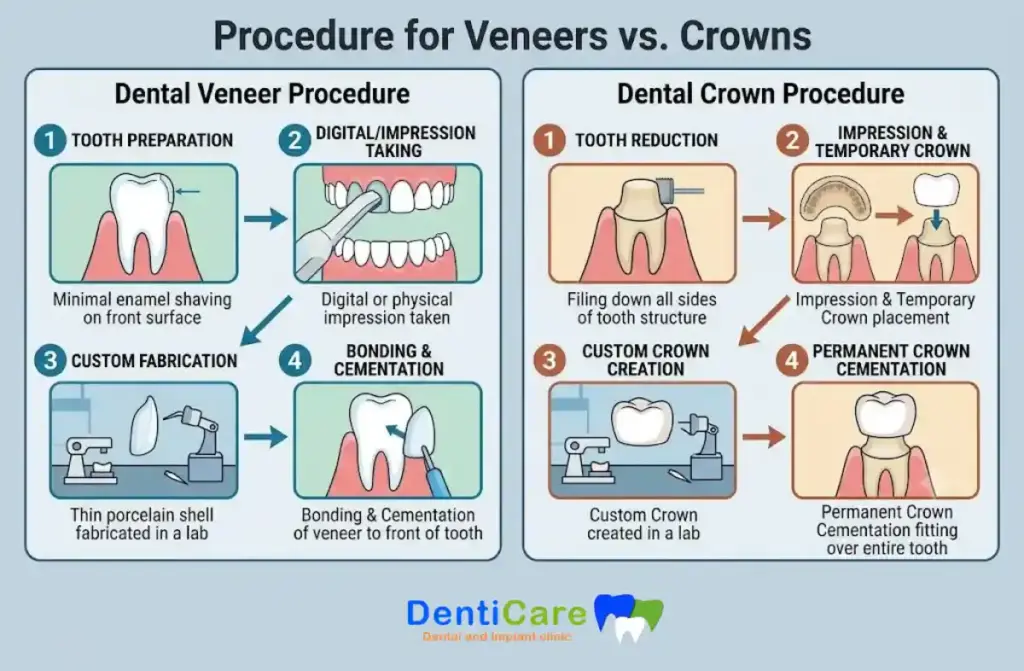
- Tooth preparation: For veneers, a thin layer of enamel is shaved off the front surface. For crowns, the entire tooth is reshaped to make room for the cap.
- Impressions and temporary restoration: Impressions are sent to a dental lab, and a temporary veneer or crown protects the tooth while the permanent piece is made.
- Fitting and bonding: Once ready, the permanent restoration is checked for shade, shape, and bite before being cemented in place.
- Follow-up: A short review appointment confirms your bite feels natural and the restoration is settling well.
Veneers generally involve less tooth reduction and mild sensitivity afterward, while crown placement — especially after a root canal — may involve a slightly longer adjustment period since more of the tooth structure is affected.
Weighing the Pros and Cons
Weighing the veneers vs crowns pros and cons side by side makes the decision easier.
Veneers: Pros and Cons
Pros: Minimal enamel removal, natural translucent appearance, quick cosmetic transformation, good for front teeth. Cons: Not suitable for teeth with major structural damage, can chip under heavy bite force, not reversible once enamel is removed.
Crowns: Pros and Cons
Pros: Full protection for damaged or root-canal-treated teeth, handles heavy chewing pressure, long-lasting with strong materials like zirconia. Cons: Requires more enamel removal, generally costs more per tooth, slightly longer procedure.
Benefits and Disadvantages, Compared
Veneers vs Crowns Benefits
The core benefits of each option come down to what it protects. Veneers offer a fast, conservative way to brighten and reshape a smile with minimal tooth alteration. Crowns offer complete structural reinforcement, letting a cracked or root-canal-treated tooth function normally for years without risk of further breakdown.
Veneers vs Crowns Disadvantages
On the flip side, the drawbacks of each option are just as tooth-specific. Veneers can’t fix a tooth that’s structurally weak — they simply aren’t designed for it, and using one on a compromised tooth can lead to failure. Crowns, meanwhile, involve more aggressive tooth reshaping, which is irreversible, and tend to cost more than a single veneer.
Are Crowns Better Than Veneers?
There’s no universal answer to are crowns better than veneers — it depends entirely on what the tooth needs. Crowns are the better choice when a tooth is cracked, has a large filling, or has undergone root canal treatment, since they restore both strength and appearance. Veneers are better when the tooth itself is healthy and the goal is purely cosmetic — fixing color, shape, or minor gaps. Neither option is universally “better”; the right one depends on your tooth’s condition, not personal preference alone.
Cost Comparison: Veneers and Crowns in India
Cost is often the deciding factor once patients have narrowed things down to veneers vs crowns. As a general guide in India:
- Porcelain veneers: approximately ₹8,000–₹20,000 per tooth
- Composite veneers: approximately ₹3,000–₹8,000 per tooth
- Zirconia crowns: approximately ₹8,000–₹18,000 per tooth
- PFM (porcelain-fused-to-metal) crowns: approximately ₹4,000–₹8,000 per tooth
- E-max crowns: approximately ₹10,000–₹20,000 per tooth
Book a consultation for an exact quote based on your tooth condition and material choice.
How to Decide: Which One Is Right for You?
Ask yourself these questions before choosing between veneers and crowns:
- Is the tooth structurally healthy? If yes, a veneer is usually sufficient. If it’s cracked, decayed, or root-canal-treated, a crown is the safer long-term option.
- Is it a front tooth or a back tooth? Veneers are almost always used on front teeth. Molars under heavy bite force typically need a crown.
- What’s your budget and timeline? Veneers can be less expensive per tooth if only a few need treatment, while crowns are often the better long-term investment for damaged teeth.
- What does your dentist recommend after examination? X-rays and a clinical exam will reveal enamel thickness, decay, and bite alignment — details you can’t judge on your own.
Denticare’s Cosmetic Dentistry – Veneers and Crowns and Bridges pages have more detail on each treatment, and our Smile Design service can help if you’re planning a full smile makeover rather than a single tooth.
Conclusion
Choosing between veneers vs crowns isn’t about which one is objectively superior — it’s about matching the treatment to your tooth. Veneers are the conservative, cosmetic-first choice for healthy front teeth. Crowns are the structural workhorse for teeth that need real protection. The most reliable way to decide is a clinical exam, since X-rays and an in-person check will show what your teeth actually need rather than what looks simplest on paper.