Many people want straighter teeth but do not want to wear metal braces for a year or more. Some worry about how braces will look at work, in college or in family photos. Others find wires and brackets hard to clean and uncomfortable to live with. Invisalign clear aligners offer another way to straighten teeth. At Denticare Dental & Implant Clinic in Mogappair, Invisalign treatment in Chennai is planned with a digital scan, a careful examination, and a clear explanation of what the aligners can and cannot do for you.
Straight teeth are not only about looks. Teeth that are crowded or out of line are harder to clean, which can raise the risk of decay and gum problems. A poor bite can also put extra load on some teeth and on the jaw joint. Correcting tooth position can make daily cleaning easier and help your teeth work together better.
This page explains what Invisalign is, how it moves teeth, who it suits, how the treatment works, how long it takes, what daily life with aligners is like, and what affects the cost. The aim is to help you make an informed choice about your smile.
What is Invisalign?
Invisalign is a brand of clear aligners. Clear aligners are thin, removable plastic trays that fit snugly over your teeth. Each aligner is made for your mouth only. It applies gentle, steady pressure that moves your teeth a little at a time.
You wear one set of aligners for about one to two weeks. Then you move on to the next set in the series. Each new set is shaped slightly differently from the last. Over months, these small changes add up, and your teeth move into the planned position.
Because the trays are clear, many people call them invisible braces or clear braces. They are not completely invisible, but most people around you will not notice them during normal conversation.
The aligners are planned using 3D images of your teeth. This means your dentist can see the expected tooth movement on screen, stage by stage, before treatment begins.
How Do Clear Aligners Move Teeth?
Teeth are not fixed rigidly in the jaw. Each tooth sits in a socket of bone and is held in place by a thin layer of fibres called the periodontal ligament. When steady, gentle pressure is placed on a tooth, the bone on one side slowly breaks down and new bone forms on the other side. This allows the tooth to move a small distance.
Each aligner is designed to move certain teeth by a fraction of a millimetre. When you switch to the next aligner, the movement continues. This slow and controlled process is the same basic principle that braces use. The difference is that aligners use plastic trays rather than brackets and wires.
Attachments
Some tooth movements, such as turning a tooth or moving it up or down, need extra grip. For this, small tooth coloured bumps called attachments may be bonded to some teeth. They are made from the same kind of material used for white fillings. Attachments help the aligner hold and push the tooth in the right direction. They are removed and the teeth are polished once treatment ends.
Creating Small Spaces (IPR)
In some crowded cases, there is not enough room for all the teeth to line up. Your dentist may suggest removing a very thin layer of enamel from between certain teeth. This is called interproximal reduction, or IPR. It creates a small amount of space without removing teeth. Your dentist will explain if this is needed in your plan and why.
About Denticare Dental & Implant Clinic
Denticare Dental & Implant Clinic is a family dental practice on Pari Road in Mogappair East, Chennai. The clinic offers general, preventive, cosmetic, orthodontic and implant care in one place. Orthodontic options at the clinic include metal braces, ceramic braces, self ligating braces, Myobrace for children and clear aligners such as Invisalign.
Because the clinic offers both braces and aligners, your dentist can explain each option fairly. If Invisalign is not the right choice for your teeth, you will be told so and shown other options that may work better. The goal is a result that is healthy and stable, not just a quick change.
Before any orthodontic treatment begins, the dentist also checks for decay, gum problems and old fillings that may need attention. Treating these first gives your teeth a healthy base to move from.
Patients visit Denticare for clear aligners in Chennai from Mogappair East, Mogappair West, Anna Nagar, Ambattur, Koyambedu, Padi, Villivakkam and nearby areas. For families living close by, having Invisalign in Mogappair means review visits are easy to fit around work, school and college.
Types of Invisalign Treatment
There are different Invisalign options based on how much your teeth need to move. Your dentist will suggest the right one after a scan and examination.
| Type | Suited for | Usual duration |
| Invisalign Express | Very small corrections, such as minor relapse after old braces | About 3 to 6 months |
| Invisalign Lite | Mild crowding or spacing | About 6 to 8 months |
| Invisalign Full | Moderate to more complex cases | About 12 to 24 months |
| Invisalign Teen | Teenagers with permanent teeth | Depends on the case |
The type of Invisalign chosen is one of the main factors in the total treatment time and cost.
Dental Problems Invisalign Can Help With
Invisalign can correct many common tooth position and bite problems, mainly in mild to moderate cases.
- Crowded teeth: When there is not enough space and teeth overlap or twist. Crowded teeth trap food and plaque, which makes cleaning harder.
- Gaps between teeth: Spaces caused by small teeth, missing teeth or habits such as tongue thrusting. Gaps can let food collect and may affect the look of your smile.
- Deep bite: When the upper front teeth cover too much of the lower teeth. This can wear down the lower teeth over time.
- Underbite: When the lower teeth sit in front of the upper teeth. Mild to moderate cases may be treated with aligners.
- Crossbite: When some upper teeth sit inside the lower teeth. This can cause uneven wear and gum strain.
- Open bite: When the front teeth do not meet when you bite down. This can make biting into food harder.
- Relapse after old braces: Teeth that have shifted back after earlier braces, often because a retainer was not worn.
- General misalignment: Teeth that are slightly out of line.
Invisalign for Adults
Many adults did not have braces as children, or had braces and later saw their teeth move again. Adult teeth can still be moved safely when the gums and bone are healthy. Invisalign for adults is popular because it fits into working life. The aligners are hard to notice in meetings, presentations, and video calls. They can be taken out for important events or meals. This is one reason many working professionals ask about Invisalign treatment in Chennai.
Adults may have extra dental work, such as crowns, fillings, or missing teeth. Your dentist will plan around these and may suggest combining aligner treatment with other dental care, such as implants or bridges, once the teeth are in position.
Invisalign for Teens
Teenagers with all their permanent teeth can also be treated with clear aligners. Invisalign Teen aligners have small wear indicators that fade with use. These help parents and dentists see whether the aligners are being worn for enough hours each day.
Wearing aligners for 20 to 22 hours a day needs discipline. Parents can help by reminding their child to wear the aligners and keep them in the case. If a teenager finds it hard to wear removable aligners, fixed braces may be a better choice. Your dentist will discuss this openly with both parent and child.
Who Is a Good Candidate for Invisalign?
Invisalign may suit you if you:
- Have mild to moderate crowding, spacing, or bite problems
- Have all or most of your permanent teeth
- Have healthy teeth and gums
- Can wear the aligners for 20 to 22 hours every day
- Can keep up good brushing and flossing habits
- Prefer a less visible option than metal braces
Who May Not Be Suitable for Invisalign?
Invisalign is not the right choice for everyone. Braces or other treatments may work better if you have:
- Severe crowding or severe tooth rotation
- Complex bite problems, such as a severe overbite or underbite linked to jaw size
- Teeth with unusual shapes that aligners cannot grip well
- Many crowns, bridges, or implants in the area to be moved
- Active gum disease, which must be treated first
- Difficulty wearing aligners for the full time each day
Young children whose teeth and jaws are still growing may need a different type of orthodontic care, such as Myobrace or early treatment with braces.
Invisalign vs Braces
Choosing between Invisalign vs braces depends on your teeth, your bite, and your lifestyle.
| Feature | Invisalign | Traditional braces |
| Look | Clear and hard to notice | Metal or tooth coloured brackets are visible |
| Comfort | Smooth plastic | Brackets and wires may rub the cheeks at first |
| Suited cases | Mild to moderate | Mild to severe, including complex bites |
| Daily effort | Must be worn 20 to 22 hours a day | Fixed in place, works all the time |
| Eating | Remove aligners to eat | Some hard and sticky foods must be avoided |
| Cleaning | Brush and floss as usual | Takes more effort to clean around wires |
| Clinic visits | Review every few weeks | Adjustment visits every few weeks |
| Cost | Usually higher | Usually lower |
Both options can give good results when chosen for the right case. For some people, ceramic or self ligating braces may be a middle path, as they are less visible than metal braces but fixed in place. Your dentist will explain which one suits your teeth and lifestyle.
Benefits of Invisalign
- Less visible: The clear trays are hard to notice in daily life.
- Removable: You can take them out to eat, brush, and floss.
- Comfortable: There are no wires or sharp brackets to rub your cheeks.
- Easier cleaning: You can brush and floss your teeth normally, which helps protect against decay and gum problems during treatment.
- No food limits: Since you remove the aligners to eat, you can eat what you like.
- Planned with 3D images: You can see the planned tooth movement before you start.
- Fewer emergency visits: With no brackets or wires, there is less chance of a broken part that needs urgent repair.
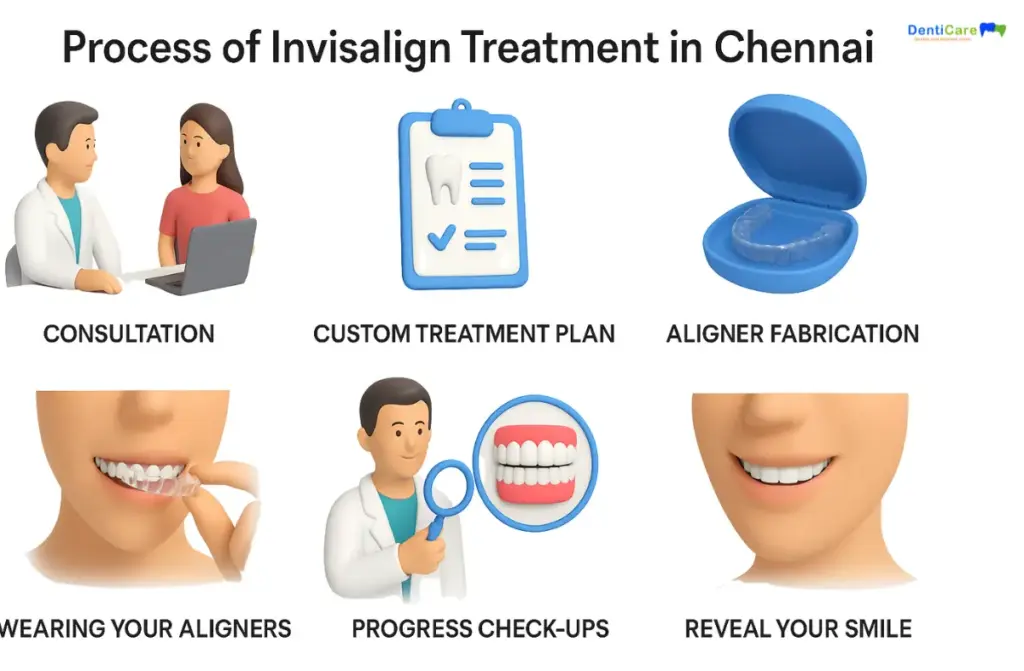
Step-by-Step Invisalign Process at Denticare
Step 1: Consultation and Examination
Your dentist checks your teeth, gums, bite and jaw. X rays may be taken to check the roots and bone. You can share what you would like to change about your smile and ask any questions you have.
Step 2: Digital 3D Scan
A small scanner takes a digital picture of your teeth. This replaces the old method of biting into impression material, which many people find uncomfortable.
Step 3: Treatment Plan
Using the scan, a step by step plan is made that shows how your teeth are expected to move. Your dentist explains this plan, the number of aligners, the likely duration, any need for attachments or IPR and the cost.
Step 4: Fitting the Aligners
Once the aligners are ready, you visit the clinic for the first fitting. Attachments are placed if needed. You are shown how to put the aligners in and take them out, and how to clean and store them.
Step 5: Wearing the Aligners and Regular Checks
You wear each set for one to two weeks before moving to the next. You visit the clinic every few weeks so the dentist can check that your teeth are moving as planned.
Step 6: Refinements if Needed
Teeth do not always move exactly as planned. Near the end, some people need a few extra aligners, called refinements, to fine tune the result. Your dentist will tell you if this is needed.
Step 7: Retainers
Once your teeth reach their new position, you will need a retainer. Retainers stop the teeth from moving back. Wearing them as advised is very important to keep your result.
Your First Week with Aligners
The first few days with a new aligner can feel strange. This is normal.
- Pressure: You may feel tightness or mild soreness for two to three days. This is a sign that the aligners are working.
- Speech: Some people notice a slight lisp at first. This usually goes away within a few days as your tongue gets used to the trays.
- Saliva: You may have a little more saliva in the first day or two.
- Edges: If an edge feels sharp, tell the clinic. It can often be smoothed.
Soft foods and cool water can help on the first day of each new set. Most people get used to their aligners within a week.
Daily Life with Invisalign
At Work and College
Clear aligners are hard to notice when you talk. Most people can speak normally once they are used to them. Carry your case and a small travel brush so you can clean up after lunch.
Eating and Drinking
Remove your aligners before every meal and snack. Drinking tea, coffee or juice with aligners in can stain them and trap sugar against your teeth. Plain water is fine.
Travel and Special Events
Always carry your aligner case and your previous set of aligners when you travel. If you lose or break your current aligner, the previous set can hold your teeth until you contact the clinic.
Sports
Aligners can be worn during most sports. For contact sports, ask your dentist whether a mouthguard is needed.
Keeping Your Teeth Healthy During Treatment
Aligners cover your teeth for most of the day. If food or sugar is trapped underneath, it can lead to decay. Good care keeps your teeth healthy throughout treatment.
- Brush twice a day with fluoride toothpaste.
- Brush or rinse after each meal before putting the aligners back in.
- Floss once a day to clean between teeth.
- Cut down on sugary snacks and drinks.
- Keep your regular dental check up and cleaning visits.
How Long Does Invisalign Take?
The time needed depends on how much your teeth need to move and how well you wear your aligners.
| Case | Approximate time |
| Minor corrections | 3 to 6 months |
| Mild cases | 6 to 8 months |
| Moderate cases | 9 to 12 months |
| Complex cases | 12 to 24 months |
Mild cases may need around 10 to 14 sets of aligners, while complex cases may need 30 or more. Not wearing aligners for the full time each day can slow down treatment and may add extra aligners at the end.
Understanding Invisalign Cost in Chennai
The cost of Invisalign treatment in Chennai is different for each person. Two people with crooked teeth may need very different plans. The main factors are:
- How complex your case is: More tooth movement usually means more aligners and a longer plan.
- The type of Invisalign plan: Express, Lite, Full and Teen differ in scope.
- The number of aligners required: Each stage of movement needs its own set.
- Length of treatment: Longer plans need more review visits.
- Extra steps: Attachments, IPR, refinements and retainers can all form part of the plan.
- Other dental work: Fillings, cleaning or gum care may be needed before aligners start.
Invisalign usually costs more than traditional braces. At Denticare, the exact cost is explained only after an examination and scan, so you know the full fee and what it includes before treatment begins. Payment options, including EMI, can be discussed at the clinic.
Questions to Ask at Your Consultation
Asking the right questions can help you decide with confidence.
- Am I a good candidate for clear aligners, or would braces suit me better?
- How long is my treatment likely to take?
- How many aligners will I need?
- Will I need attachments or IPR?
- How often will I need to visit the clinic?
- What does the fee include, and are retainers part of it?
- What happens if I lose or break an aligner?
- How long will I need to wear a retainer?
How to Care for Your Invisalign Aligners
Good care keeps your aligners clear and your treatment on track.
- Wear your aligners for 20 to 22 hours a day.
- Remove them before eating or drinking anything other than plain water.
- Brush your teeth before putting the aligners back in.
- Clean the aligners every day with cool water and a soft brush. Do not use hot water, as it can bend them.
- Do not use coloured or scented mouthwash to soak them, as it may stain the plastic.
- Keep them in their case when they are out of your mouth. Wrapping them in a tissue often leads to them being thrown away by mistake.
- Try to keep them out for no more than 30 to 60 minutes at a time.
- Attend all your review visits.
Retainers After Invisalign
After your teeth have moved, the bone and gums around them need time to settle. Without a retainer, teeth tend to drift back toward their old positions. This is called relapse.
There are two main types of retainers:
- Removable clear retainers: These look like aligners and are usually worn at night.
- Fixed retainers: A thin wire bonded behind the front teeth.
Your dentist will advise which type suits you and how long to wear it. Many people need to wear a retainer at night for the long term to keep their result.
Common Myths About Invisalign
Myth: Aligners only work for small changes.
Fact: Aligners can treat many mild to moderate cases, including some bite problems. Very complex cases may still need braces.
Myth: Invisalign is only for adults.
Fact: Teenagers with permanent teeth can also use clear aligners if they can wear them as advised.
Myth: You can wear them whenever you like.
Fact: Aligners only work when worn for 20 to 22 hours a day. Wearing them less slows progress.
Myth: Once treatment ends, teeth stay straight forever.
Fact: Teeth can move back without a retainer. Wearing a retainer is part of the treatment.
Risks and Limitations
Like any treatment, Invisalign has some limits you should know about.
- You may feel mild pressure or soreness for two to three days after each new set.
- Results depend on wearing the aligners as advised. Missing hours can delay progress.
- Some cases need refinement aligners at the end to fine tune the result.
- Poor cleaning while wearing aligners can lead to decay or gum problems.
- Teeth can move back if retainers are not worn after treatment.
- Not every case can be treated with aligners alone.
Your dentist will discuss these points with you before you start.
Why Patients Choose Denticare for Invisalign
When looking for Invisalign treatment in Chennai, it helps to choose a clinic that gives you honest advice and follows your progress closely. At Denticare, you can expect:
- A full check first: Teeth, gums and bite are examined before any plan is made.
- Clear options: Aligners, ceramic braces, self ligating braces and metal braces are all explained, with their benefits and limits.
- Digital planning: 3D scans help you see the planned tooth movement.
- Fees shared upfront: You know the cost before treatment begins.
- Regular follow up: Progress is checked at each visit.
- Care for the whole family: General, cosmetic, implant, and children’s dental care at the same clinic.
- Convenient location: Easy to reach from Mogappair, Anna Nagar, Ambattur, Padi and nearby areas.
Book a Consultation
Address: S1, Second Floor, No. 4/268, Pari Road, Mogappair East, Chennai 600 037
Phone / WhatsApp: +91 98411 00500
Email: denticare.dentists@gmail.com
To discuss Invisalign treatment in Chennai, call or send a WhatsApp message to book your visit.
Conclusion
Invisalign offers a clear, removable way to straighten teeth for many teenagers and adults. It works well for mild to moderate crowding, gaps and bite problems, as long as the aligners are worn for the advised hours every day. The trays are hard to notice, easy to clean and allow you to eat normally. At the same time, aligners are not suitable for every case, and some people will get a better result with braces.
The right choice starts with a proper examination. At Denticare Dental & Implant Clinic, your teeth are scanned and checked, your options are explained in simple words and the full cost is shared before you begin. Your progress is reviewed at every stage, and you are guided on retainers so your result lasts. If you are thinking about Invisalign treatment in Chennai, book a consultation at Denticare to find out whether clear aligners are right for you.