Medically Reviewed by Dr. Gnanaraj, BDS, MMC Chennai, PG Clinical Dentistry (Melbourne)
Principal Dentist, Denticare Dental & Implant Clinic
ASID Certified – Australian Society of Implant Dentistry
20+ years of clinical expertise in delivering advanced, patient-centered dental care
For decades, getting dental implants meant months of waiting — healing time between extraction, implant placement, and the final crown. If you had multiple missing teeth or wore dentures, that could mean a long stretch of discomfort and self-consciousness. Teeth in a Day changes that timeline dramatically, offering a full set of fixed replacement teeth in a single visit. Here’s everything you need to know before booking a consultation at Denticare Dental & Implant Clinic in Mogappair, Chennai.
What is Teeth in a Day?
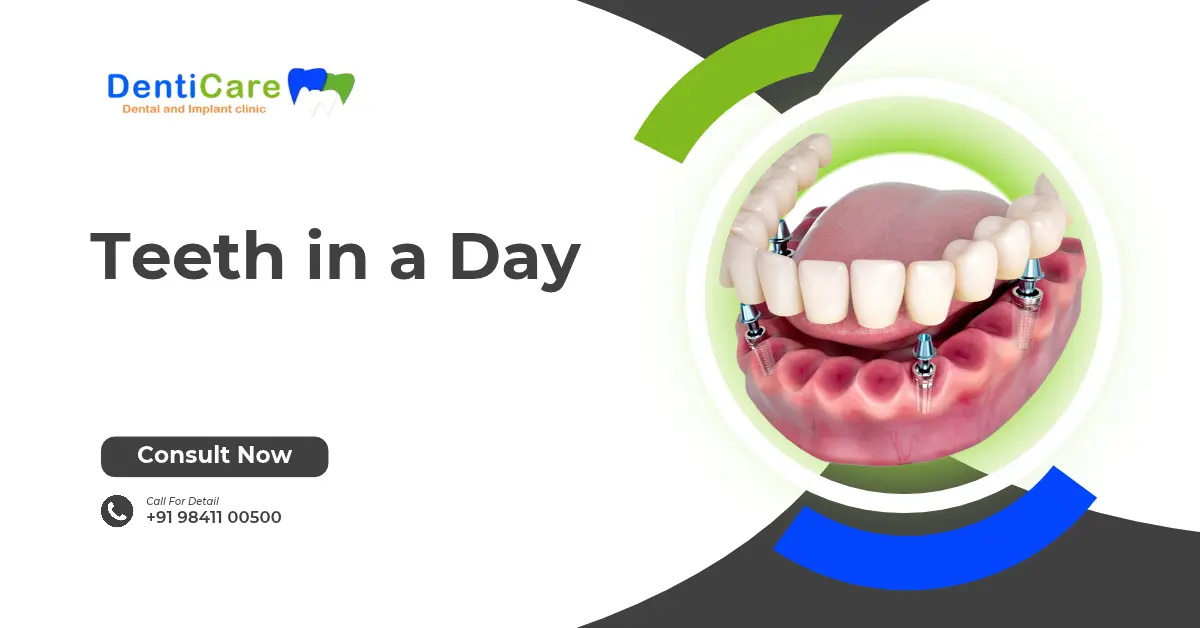
This approach — also known as same day tooth replacement, or by system names like All-on-4 and All-on-6 — is a procedure where dental implants are surgically placed and a full arch of temporary fixed teeth is attached, all within a single appointment. Instead of leaving with empty gums or a removable temporary denture, patients leave the clinic with a functional, natural-looking smile.
The key difference from traditional implants is timing. Conventional implant treatment places the implant first, then waits three to six months for it to fuse with the jawbone (a process called osseointegration) before attaching a permanent crown. This approach to teeth replacement in one day instead uses a strategic number and angle of implants to achieve enough initial stability to support a temporary prosthetic immediately, while osseointegration happens underneath. Patients missing a single tooth may also ask about a Tooth in a Day option — a single-implant version of the same same-day principle, best assessed case by case.
Quick clarification: “Same day” refers to the temporary teeth, not necessarily the final, permanent restoration. Most patients wear a temporary bridge for several months while healing completes, then transition to a final, more durable prosthetic.
Am I a Good Candidate?
Teeth in a Day works best for people who are missing several teeth in an arch, have failing teeth that need extraction, or are tired of dealing with removable dentures. Good candidates generally have:
- Sufficient jawbone density to anchor implants securely
- Healthy gums, free of active infection
- Good overall health with no conditions that impair healing
Some patients with bone loss can still qualify after a bone grafting procedure or a sinus lift, though this may add time before same day tooth replacement is possible. People with uncontrolled diabetes, heavy smokers, or those with certain autoimmune conditions should discuss risks carefully with their dentist, as healing complications are more likely.
How the Procedure Works, Step by Step
Consultation and 3D Imaging
Your dentist takes detailed 3D scans (CBCT guided planning) of your jaw to assess bone density, nerve location, and sinus position. This data is used to plan exact implant placement.
Treatment Planning
Using the scans, the team maps out precisely where each implant will go — often with guided surgery protocols to increase precision on the day of treatment.
Extractions (If Needed)
If you have failing teeth that need to come out, they’re extracted at the start of the same appointment.
Implant Placement
Typically four to six titanium (or zirconia) implants are placed per arch, angled to maximize contact with available bone — this is what allows for immediate stability without grafting in many cases. See our full All-on-4/6 Implants page for a closer look at this system.
Attaching the Temporary Teeth
A custom-made temporary bridge is secured to the implants before you leave. You walk out with a full, functional set of teeth the same day.
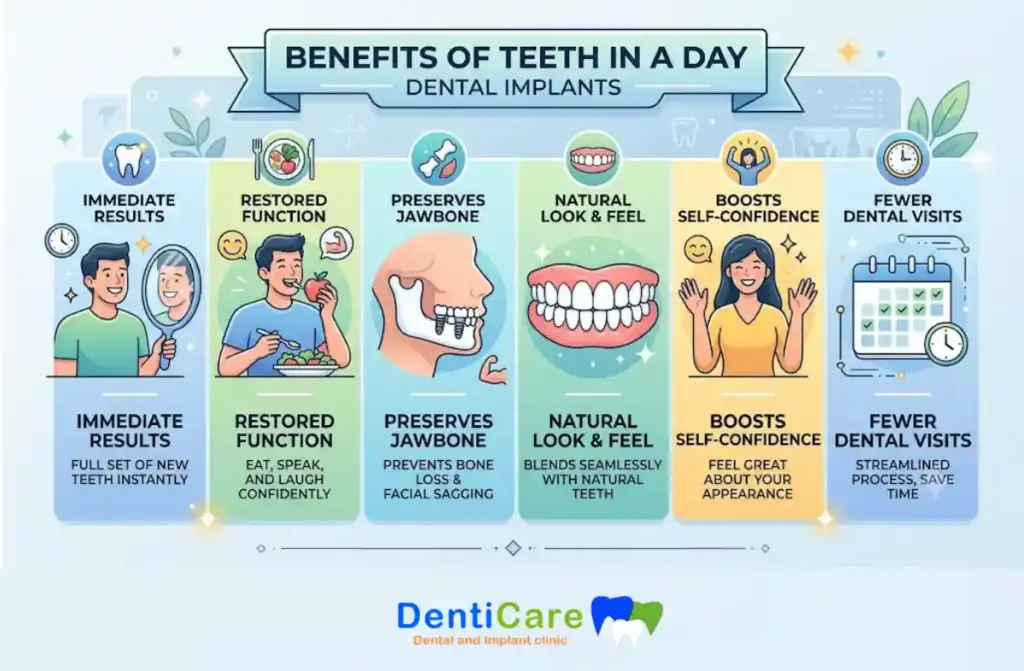
Benefits of Teeth in a Day
- Immediate results — no gap between losing teeth and having a smile again
- Fewer appointments — consolidates a process that traditionally spans months into far fewer visits
- Improved function — better chewing and speech almost right away
- Boosted confidence — no visible gaps during the healing period
- Long-term stability — implants integrate with the jawbone, unlike removable dentures
Risks, Limitations, and Recovery
Like any surgical procedure, same day tooth replacement comes with realistic expectations to keep in mind. Expect some swelling, soreness, and bruising for the first several days. A soft-food diet is usually required for weeks to months while the implants heal, gradually reintroducing firmer foods as advised by your dentist.
Because the temporary prosthetic is load-bearing almost immediately, there’s a small risk of implant complications if the bone doesn’t fuse properly or if oral hygiene is neglected — this is where experienced failed implant management expertise matters if issues do arise. Smoking, poorly controlled diabetes, and grinding or clenching habits (bruxism) can all slow healing or put extra strain on new implants, so flagging these to your dentist upfront allows the treatment plan to account for them. Following your dentist’s aftercare instructions closely — gentle brushing around the surgical sites, avoiding hard or sticky foods too soon, and attending follow-up visits — is critical to long-term success.
The final, permanent prosthetic — usually made from a more durable material such as zirconia — is placed once healing is complete, generally three to six months after surgery.
Cost of Same Day Tooth Replacement in Chennai
Pricing for tooth replacement in one day varies based on the number of implants, materials used (titanium vs. zirconia), and whether bone grafting or a sinus lift is needed. Because every case is different, Denticare provides a detailed, itemized quote after your CBCT scan and consultation rather than a generic estimate — book a consultation for exact pricing for your case.
Dental insurance in India often covers only a portion of implant-related treatment, if any. Ask our team about available payment and EMI options during your visit.
Why Choose Denticare for Same Day Tooth Replacement
Denticare Dental & Implant Clinic in Mogappair is led by Dr. Gnanaraj Jayabal, who brings over 20 years of clinical experience — including six and a half years practicing in Melbourne, Australia — to implant planning and same-day cases. The clinic uses CBCT-guided and guided-surgery protocols, ADA cross-infection control standards, and has treated 5,000+ patients. If you’re comparing options near Mogappair, Anna Nagar, or elsewhere in Chennai, a consultation with detailed imaging is the best next step.
Same-Day Implants vs. Traditional Implants vs. Dentures
Not sure which route fits your situation? Here’s how this same-day option stacks up against a traditional implant timeline and conventional dentures.
| Factor | Teeth in a Day | Traditional Implants | Removable Dentures |
| Timeline | Fixed teeth same day; final restoration in months | Months between placement and final crown | Can be fitted relatively quickly |
| Stability | High — anchored to implants | High — anchored to implants | Lower — can shift or slip |
| Comfort | Functions like natural teeth | Functions like natural teeth | May cause irritation, requires adhesives |
| Cost | Higher upfront investment | Comparable, spread over longer timeline | Generally lower cost |
Titanium vs. Zirconia: Which Implant Material Is Right for You?
Most Teeth in a Day cases use titanium implants, which have decades of clinical research behind them, excellent long-term success rates, and lower cost. Zirconia implants are a newer, metal-free alternative — popular with patients who prefer a tooth-colored implant body or have a sensitivity to metal. Zirconia tends to cost more and, because it’s a one-piece design in most systems, offers slightly less flexibility during placement. Your dentist will recommend a material based on your bite, bone quality, and aesthetic priorities during the CBCT-guided planning stage rather than a one-size-fits-all default.
What to Expect: Day-by-Day Recovery Timeline
Recovery after same day tooth replacement follows a fairly predictable pattern, though individual healing varies:
- Day 1–3: Swelling and mild-to-moderate discomfort peak, usually managed with prescribed pain relief. Stick to cold, soft foods (yogurt, soups, smoothies) and avoid the surgical sites when brushing.
- Day 4–7: Swelling begins to subside. Most patients can return to light work and daily activities, though strenuous exercise is still discouraged.
- Week 2–4: Soreness resolves for most patients. You can gradually reintroduce firmer foods as your dentist advises, while still avoiding very hard or sticky items.
- Month 1–3: Osseointegration continues beneath the temporary bridge. Regular check-ins let your dentist monitor healing and address any looseness or irritation early.
- Month 3–6: Once integration is confirmed, impressions are taken for the final, permanent prosthetic, which replaces the temporary bridge.
How to Prepare for Your Teeth in a Day Appointment
A little preparation makes the procedure smoother and recovery easier:
- Arrange for someone to drive you home if sedation is planned — you won’t be fit to drive yourself afterward.
- Stock your kitchen with soft, cold, and lukewarm foods before your appointment so you’re not shopping while sore.
- Follow any fasting instructions given by your dental team if sedation or general anesthesia is involved.
- List current medications and health conditions for your dentist, including any blood thinners, as these can affect surgical planning.
- Clear a few days in your schedule for rest, even though many patients feel well enough to work within a day or two.
Myths vs. Facts About Teeth in a Day
Myth: “Same day” means you’re fully done in one visit. Fact: You leave with fixed, functional teeth the same day, but the final permanent prosthetic follows months later, once the implants have fully integrated.
Myth: Anyone missing teeth qualifies automatically. Fact: Candidacy depends on bone density, gum health, and overall medical history — some patients need grafting or a longer timeline first.
Myth: It’s more painful than traditional implants. Fact: The surgery itself is done under anesthesia or sedation either way; recovery discomfort is generally comparable, not worse.
Conclusion
Missing or failing teeth don’t have to mean months of waiting before you feel like yourself again. Same day tooth replacement gives you a fixed, functional smile in a single visit, while the final, permanent restoration is placed once healing is complete. It isn’t the right fit for everyone — bone density, gum health, and overall medical history all play a role — which is why a proper consultation and CBCT scan matter more than any online estimate. If you’re in Chennai and considering this option, the team at Denticare can walk you through whether you’re a candidate and what the process would look like for your specific case.