Every year, many people look for dental care in India. Some live in other Indian cities and want a dentist with specific training. Others are Indians living abroad who prefer to get treatment done during a visit home. Some are international patients who have heard that quality dental care is available here at a lower cost than in many other countries. Whatever your reason, choosing a dentist in India needs the same care as choosing a dentist anywhere else.
Denticare Dental & Implant Clinic in Mogappair East, Chennai, is led by Dr. Gnanaraj Jayabal, a dentist with over 20 years of clinical experience in India and Australia. The clinic offers general, preventive, cosmetic, orthodontic, implant and children’s dental care in one place. This page explains how to choose a dentist, what treatments are available, what to expect if you are travelling for treatment and how to look after your teeth before and after care.
How to Choose a Dentist in India
India has a large number of dental clinics, and standards can vary. A careful choice is based on facts you can check, not on advertising words.
- Check registration: Every practising dentist in India must be registered with the Dental Council of India or a State Dental Council. You can ask the clinic for the registration number.
- Look at training: Find out where the dentist studied and what further training they have done for the treatment you need.
- Ask about experience: Ask how long the dentist has been practising and how often they carry out your treatment.
- Ask about sterilisation: A safe clinic sterilises instruments in an autoclave after every patient and uses single use items where possible.
- Check the equipment: Digital X rays, CBCT scans and intraoral scanners help with accurate diagnosis and planning.
- Ask for a written plan: You should receive a written treatment plan with an itemised cost before treatment starts.
- Ask about follow up: Find out how complications, repairs or reviews are handled after treatment.
- Judge communication: A good dentist explains your condition clearly and answers your questions without pressure.
Meet Dr. Gnanaraj Jayabal, Principal Dentist
- Qualification: BDS
- Education: BDS from Government Dental College (Madras Medical College), Chennai; Postgraduate training in Clinical Dentistry, Melbourne, Australia
- Implant training: ASID (Australian Society of Implant Dentistry) accreditation at all three levels, completed in Sydney; Zygoma implant surgery training in 2018
- Experience: Over 20 years in clinical dentistry, including about six and a half years in Australia
Training in India and Australia
Dr. Gnanaraj Jayabal earned his dental degree from the Government Dental College, Madras Medical College, Chennai. He then completed postgraduate training in clinical dentistry in Melbourne, Australia.
Clinical Experience
He practised in Australia for about six and a half years in both public and private settings, including Dental Health Services Victoria (DHSV) and the Royal Dental Hospital of Melbourne. This work gave him exposure to a wide range of dental conditions and to strict standards of infection control and patient safety. He later returned to Chennai and set up Denticare Dental & Implant Clinic in Mogappair East.

Areas of Clinical Focus
His work covers dental implants, root canal treatment, cosmetic dentistry, and full mouth rehabilitation. Implant dentistry is a major part of his practice. He completed ASID accreditation at all three levels and trained in zygoma implant surgery, which is used in selected cases where the upper jaw has very little bone.
Approach to Patient Care
Dr. Gnanaraj Jayabal examines patients personally and explains findings in simple words. He discusses each treatment option with its benefits, limits and cost. Treatment starts only after the patient understands and agrees with the plan.
About Denticare Dental & Implant Clinic
Denticare Dental & Implant Clinic is a family dental practice on Pari Road in Mogappair East, Chennai. Patients visit from across Chennai, from other parts of Tamil Nadu and India, and from abroad.
The clinic follows a clear approach for every patient:
- Listen first: Your concerns and goals are heard before the examination.
- Explain clearly: X rays, scans and photos are used to show what is happening.
- Offer choices: Where more than one treatment is possible, each option is explained.
- Share costs upfront: You receive a cost estimate before treatment begins.
- Plan follow up: Aftercare and review visits are planned in advance.
For people looking for a dental clinic in Chennai that offers general, specialist and implant care under one roof, Denticare provides a single point of care for the whole family.
Dental Treatments Available at Denticare
Preventive and General Dentistry
- Dental check ups and oral examination
- Professional cleaning (scaling and polishing)
- Fluoride treatment
- Fissure sealants for children
- Oral hygiene guidance
Root Canal Treatment
Root canal treatment removes infection from inside a tooth and saves the natural tooth. It is done under local anaesthesia. A crown is often placed afterwards to protect the tooth. Pulp therapy is also available for children’s milk teeth.
Dental Implants
Dental implants replace the root of a missing tooth and support a crown, bridge or denture. Implant options at Denticare include:
- Single and multiple tooth implants
- All on 4 and All on 6 full arch options
- Zygoma implants for selected low bone cases
- Bone grafting and sinus lifting
- CBCT guided planning and guided surgery
- Short implants and zirconia implants
- Management of failed implants
For patients considering dental implants in India, planning with a CBCT scan helps the dentist check bone height, width and nearby structures before surgery.
Cosmetic Dentistry
- Teeth whitening
- Veneers
- Smile design
- Micro abrasion for surface stains
- Gingival depigmentation for dark gums
Orthodontics
- Metal braces
- Ceramic braces
- Self ligating braces
- Clear aligners, including Invisalign
- Myobrace and interceptive orthodontics for growing children
Restorative Dentistry
- Tooth coloured fillings
- Crowns, including ceramic, e.max, zirconia and DMLS options
- Bridges, including Maryland bridges
- Dentures
Gum Care
- Scaling and root planing
- Subgingival curettage
- Flap surgery
- LANAP laser gum treatment
- Treatment for loose (mobile) teeth
Children’s Dentistry
Children’s care includes check ups, fluoride, sealants, fillings and pulp therapy. Where needed, laughing gas (nitrous oxide) sedation, IV sedation or general anaesthesia may be discussed with parents in detail before treatment.
Other Treatments
- Full mouth rehabilitation for badly worn, broken or missing teeth
- Bruxism (teeth grinding) management
- Treatment for bad breath (halitosis)
- Minor oral surgery and wisdom tooth removal
Technology and Infection Control
Modern equipment supports accurate diagnosis and careful treatment. Denticare uses:
- Digital OPG X ray: One image showing all teeth, both jaws and the jaw joints.
- PSP digital radiography: Clear digital X rays with a lower radiation dose than film.
- CBCT guided planning: 3D imaging for implants and complex cases.
- iTero scanner: Digital scans for clear aligner planning, in place of impression material.
- Dental laser: For selected gum and soft tissue procedures.
Infection control follows ADA cross infection control standards. Instruments are sterilised in an autoclave, single use disposable items are used where possible and HEPA air filtration helps keep the clinic air clean.
Step by Step Treatment Process
Step 1: Consultation and Diagnosis
Your medical and dental history is reviewed. The dentist examines your teeth, gums and bite. Digital X rays or scans are taken if needed.
Step 2: Treatment Plan
You receive a plan that lists the treatment options, the number of visits, the expected timeline and the cost.
Step 3: Treatment
Treatment is carried out with local anaesthesia where needed. Each step is explained before it is done.
Step 4: Aftercare and Follow Up
You receive written aftercare advice. Review visits are planned to check healing and results.
Dental Treatment in India for Patients from Other Cities and Countries
Many people plan dental treatment in India while visiting family or as part of a planned trip. This is often called dental tourism. Careful planning helps you get safe care and avoid problems after you return home.
Before You Travel
- Share records early: Send recent X rays, scans and dental reports to the clinic by email or WhatsApp and ask whether an early review is possible.
- Ask for a provisional plan: A final plan can only be made after an examination, but a provisional plan helps you estimate time and cost.
- Plan enough time: Simple treatments may need one or two visits. Implants, braces and full mouth care may need several visits over weeks or months.
- Check your health: Tell the dentist about any medical conditions, medicines and allergies. Carry recent blood reports if you have diabetes or take blood thinners.
For Indians Living Abroad
Many Indians living in the Gulf, Singapore, the UK, the USA and other countries plan dental work during their visits home. This can work well when the plan fits the time you have.
- Short visits: Check ups, cleaning, fillings, whitening and many root canals can often be completed in one trip.
- Longer treatment: Implants usually need two stages, with a healing gap of a few months. Some patients have the implant placed on one trip and the final teeth fixed on the next trip.
- Braces and aligners: These need regular reviews over many months. Ask the dentist how reviews can be managed if you live abroad.
- Family visits: Many families use the trip to get check ups done for parents and children at the same time.
Time Needed for Common Treatments
| Treatment | Usual visits | Notes |
| Check up and cleaning | 1 visit | Can often be done on the same day |
| Fillings | 1 visit per tooth or group of teeth | Depends on number of teeth |
| Root canal treatment | 1 to 3 visits | A crown may need an extra visit |
| Crowns and bridges | 2 visits or more | Time needed for lab work |
| Dental implants | 2 stages, usually months apart | Healing time is needed before the final teeth |
| Braces or aligners | Many months | Regular reviews are needed |
| Full mouth rehabilitation | Several visits | Planned in stages |
After You Return Home
- Keep copies of your X rays, treatment notes and implant details (brand and size).
- Follow the aftercare instructions closely.
- Arrange check ups with a local dentist if you cannot return for reviews.
- Contact the clinic by phone or WhatsApp if you have questions.
Understanding the Cost of Dental Treatment
Dental treatment costs depend on your condition, the number of teeth involved, the treatment type and the materials used. For example, a crown can be metal, ceramic, e.max or zirconia, and each has a different fee. Implant costs depend on the number of implants, the implant system, the crown type and whether bone grafting or a sinus lift is needed.
Costs for dental treatment in India are often lower than in countries such as the USA, the UK and Australia. However, cost should never be the only reason to choose a clinic. Training, hygiene, planning and follow up matter just as much.
At Denticare, the cost is explained only after an examination. You receive an estimate that shows what is included, such as surgery, implant fixture, abutment and crown, and what may be quoted separately, such as bone grafting or a sinus lift. Payment options, including EMI, can be discussed at the clinic.
Common Dental Problems and How They Are Treated
Tooth Decay
Decay forms when germs in plaque turn sugar into acid that wears away enamel. Early decay is treated with a filling. Deeper decay that reaches the nerve may need root canal treatment and a crown.
Gum Disease
Gum disease starts as red, swollen gums that bleed when you brush. Without treatment, it can damage the bone that holds the teeth, and teeth may become loose. Treatment ranges from deep cleaning to gum surgery or laser gum care.
Missing Teeth
Missing teeth make chewing harder, allow nearby teeth to drift and can lead to bone loss in the jaw. Options include bridges, dentures and implants. Your dentist will explain which option suits your bone, gums and budget.
Worn and Broken Teeth
Grinding, acidic food and drinks, and age can wear teeth down. Injuries can crack or break them. Crowns, veneers and full mouth rehabilitation can restore shape, strength and bite.
Crooked Teeth
Crowded or uneven teeth are harder to clean and may affect your bite. Braces and clear aligners can move teeth into a better position.
Bad Breath
Long lasting bad breath is often caused by gum disease, decay, a coated tongue or dry mouth. Finding the cause is the first step to treating it.
Common Dental Myths
Myth: No pain means no problem.
Fact: Early decay and gum disease often cause no pain. Regular check ups find them early.
Myth: Bleeding gums are normal.
Fact: Healthy gums do not bleed with gentle brushing. Bleeding is often a sign of gum inflammation.
Myth: Milk teeth do not need care.
Fact: Milk teeth help children chew, speak and hold space for adult teeth. Decay in milk teeth can cause pain and infection.
Questions to Ask at Your Consultation
- What is causing my problem, and what are my treatment options?
- What are the benefits and limits of each option?
- How many visits will I need, and over how long?
- What is the total cost, and what does it include?
- What should I expect after treatment, and how do I care for my teeth?
- What happens if I have a problem after treatment?
- Who will carry out my treatment?
Writing these questions down before your visit helps you get clear answers and make a confident decision.
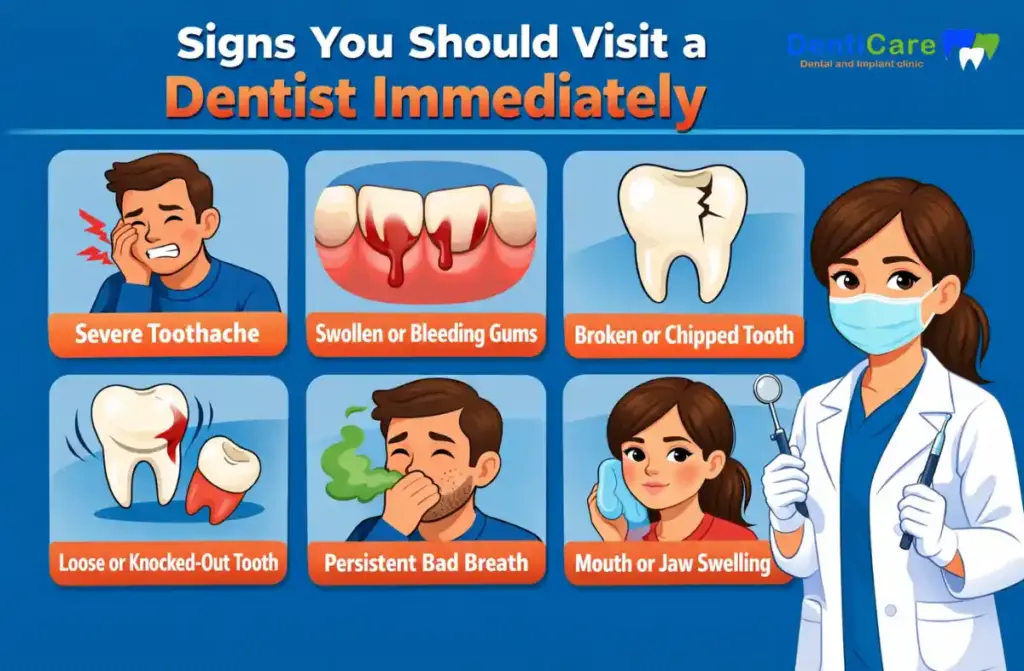
Signs You Should Visit a Dentist Soon
| Sign | What it may mean | How soon to visit |
| Severe toothache | Decay or infection | Within a day or two |
| Swelling in the face or gums | Infection or abscess | As soon as possible |
| Loose adult teeth | Gum disease or bone loss | Soon |
| Bleeding gums | Gum disease | Within a few weeks |
| Sudden sensitivity to hot or cold | Decay or worn enamel | Within a few weeks |
| Broken or cracked tooth | Trauma or weak tooth | Within a few days |
| Mouth sore that does not heal in two weeks | Needs examination | Soon |
| Bad breath or bad taste that does not go | Gum problems or decay | Within a few weeks |
| Jaw pain or trouble chewing | Jaw joint (TMJ) or bite problem | Within a few weeks |
Benefits of Regular Dental Check Ups
- Early detection: Decay and gum disease are found before they cause pain.
- Professional cleaning: Removes hard deposits (tartar) that brushing cannot remove.
- Gum disease prevention: Regular cleaning keeps gums healthy.
- Lower long term cost: Small fillings cost less than root canals or implants.
- Better overall health: Gum health is linked with conditions such as diabetes and heart disease.
- Fresher breath: Cleaning and gum care help control bad breath.
- Personal advice: Your dentist can guide you on brushing, flossing and diet.
Emergency Dental Care
Some dental problems need quick attention:
- Severe toothache
- Broken or cracked teeth
- A tooth knocked out by an injury
- Swelling or infection in the face or gums
- A lost filling or crown
If you have a dental emergency, call the clinic before you come so the team can prepare for your visit. If a permanent tooth is knocked out, hold it by the crown, keep it moist in milk and reach a dentist quickly.
Oral Health Tips for a Healthy Smile
Daily Care
- Brush twice a day for two minutes with fluoride toothpaste.
- Clean between your teeth with floss or interdental brushes every day.
- Use mouthwash if your dentist advises it.
- Replace your toothbrush every three months.
- Visit a dentist every six months.
Foods That Support Oral Health
- Calcium rich foods such as milk, curd and paneer
- Crunchy fruits and vegetables such as apples, carrots and cucumber
- Plenty of water through the day
Habits to Avoid
- Smoking and chewing tobacco, which harm gums and raise the risk of oral cancer
- Frequent sugary snacks and sweet drinks
- Using teeth to open packets or bottles
- Ignoring pain, bleeding or swelling
Why Patients Visit Denticare
When choosing a dentist in India, patients want clear information and safe care. At Denticare, you can expect:
- Personal care: Dr. Gnanaraj Jayabal examines and plans each case himself.
- Training in India and Australia: Over 20 years of clinical experience.
- Implant training: ASID accreditation and zygoma implant training.
- Clear communication: Findings and options explained in simple words.
- Written plans and upfront costs: You know the plan and fee before treatment.
- Infection control: Autoclave sterilisation, single use items and HEPA air filtration.
- Complete care: General, cosmetic, orthodontic, implant and children’s dentistry in one place.
Patients who live in Chennai often look for a dentist in Chennai with this range of care close to home, while patients from other cities value having many treatments available at one clinic.
Book Your Appointment
Address: S1, Second Floor, No. 4/268, Pari Road, Mogappair East, Chennai 600 037
Phone / WhatsApp: +91 98411 00500
Email: denticare.dentists@gmail.com
Timings:
- Monday to Saturday: 9:30 AM to 2:00 PM and 4:30 PM to 9:15 PM
- Sunday: Closed
Patients from outside Chennai can call or send a WhatsApp message to discuss their needs and plan their visit.
Conclusion
Choosing a dentist in India is an important decision, whether you live in Chennai, in another Indian city or abroad. The right choice is based on proper registration, training, experience, hygiene, clear communication and honest costs, not on advertising words.
At Denticare Dental & Implant Clinic, Dr. Gnanaraj Jayabal brings over 20 years of clinical experience from India and Australia, with a strong focus on implant dentistry, root canal treatment, cosmetic care, and full mouth rehabilitation. Each patient receives a careful examination, a written plan, and a clear cost estimate before treatment begins. If you are looking for a dentist in India for yourself or your family, call or WhatsApp Denticare to plan your visit.