
Medically Reviewed by Dr. Gnanaraj, BDS, MMC Chennai, PG Clinical Dentistry (Melbourne)
Principal Dentist, Denticare Dental & Implant Clinic
ASID Certified – Australian Society of Implant Dentistry
20+ years of clinical expertise in delivering advanced, patient-centered dental care
Losing a tooth can change more than your smile. It can make chewing harder, affect the way you speak and make you hold back when you laugh. Over time, the gap can also cause nearby teeth to tilt and the jawbone under it to shrink. Many people put off replacing a missing tooth because they are unsure about the options, the process or the cost.
A dental implant is one way to replace a missing tooth with something that looks, feels and works much like a natural tooth. At Denticare Dental & Implant Clinic, located in Mogappair close to Anna Nagar, we help patients looking for dental implants in Anna Nagar and nearby areas understand whether implants suit them and what the treatment involves.
Every implant treatment at our clinic is planned and carried out by Dr. Gnanaraj Jayabal, our principal dentist and founder. This page explains what dental implants are, who can have them, how they compare with bridges and dentures, the treatment steps, recovery, long term care and the factors that affect cost. It is written to help you make a calm, informed decision.
What Is a Dental Implant?
A natural tooth has two main parts. The crown is the white part you see when you smile. The root sits inside the jawbone and holds the tooth in place.
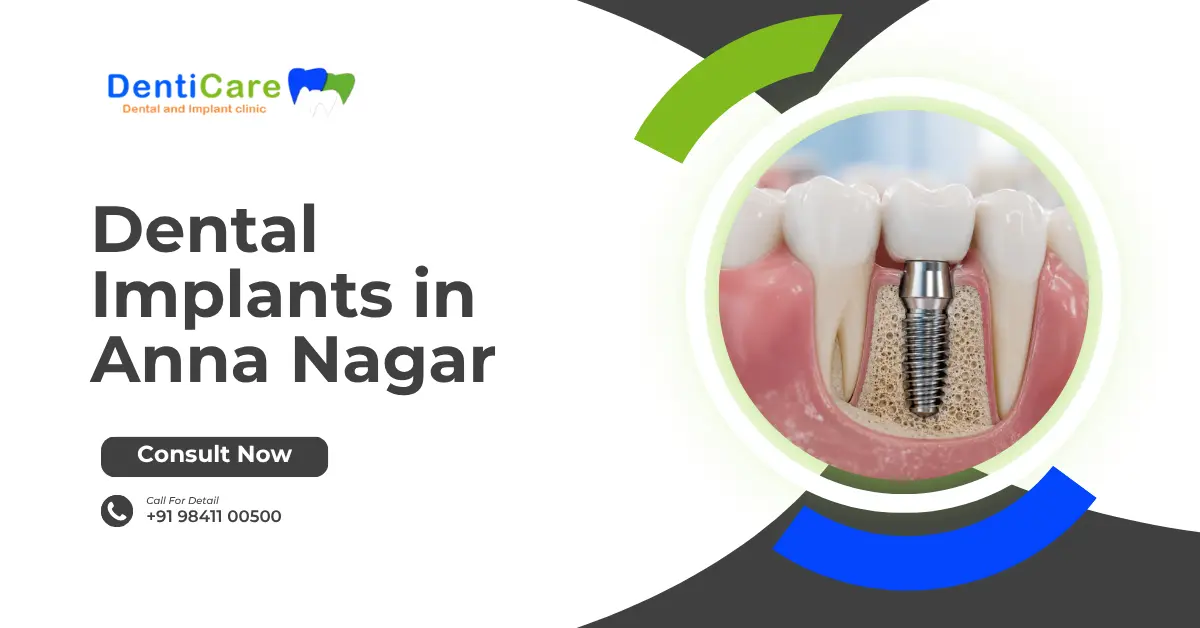
A dental implant replaces the root. It is a small, screw shaped post, usually made of titanium, that is placed into the jawbone where the tooth is missing. Over the following weeks and months, the bone grows around the implant and holds it firmly. Dentists call this osseointegration, which simply means the bone and implant join together.
Once the implant is stable, a small connector called an abutment is attached. A custom made crown is then fixed on top. The finished tooth stays in place when you eat, talk and smile.
How Implants Differ From Bridges and Dentures
A bridge fills a gap by resting on the teeth on either side, which need to be trimmed to support it. A denture sits on the gums and can be removed. An implant is anchored in the bone on its own, so it does not depend on nearby teeth and does not move while you chew.
Who Can Get Dental Implants in Anna Nagar?
Many adults with missing teeth can have implants. You may be a suitable candidate for dental implants in Anna Nagar if you:
- Have lost one or more teeth because of decay, injury or gum disease
- Have a damaged tooth that needs to be removed
- Find your dentures loose, uncomfortable or hard to chew with
- Have a bridge that has failed or keeps coming loose
- Have healthy gums, or are willing to treat gum disease first
- Have enough jawbone, or bone that can be rebuilt with grafting
- Are able to keep up good daily brushing and regular check ups
When Extra Care Is Needed
Some health conditions do not rule out implants but need careful planning:
- Diabetes: well controlled diabetes is usually fine, but high sugar levels can slow healing.
- Smoking: smoking reduces blood flow to the gums and raises the chance of implant problems.
- Gum disease: active gum infection must be treated before an implant is placed.
- Teeth grinding: grinding puts extra force on implants, so a night guard may be advised.
- Certain medicines: some bone and blood thinning medicines must be discussed with your doctor first.
There is no fixed upper age limit for implants. What matters most is your general health, your bone and the condition of your gums. A detailed check helps your dentist decide what is safe for you.
Benefits of Dental Implants
- Helps protect the jawbone: an implant puts gentle pressure on the bone while chewing, which helps slow bone loss in that area.
- Leaves healthy teeth untouched: unlike a bridge, the teeth next to the gap do not need to be trimmed.
- Better chewing: implants stay fixed, so most people can eat a wider range of foods than with dentures.
- Natural look: a well matched crown blends in with the teeth around it.
- Stable and comfortable: there is no slipping, clicking or need to remove the tooth at night.
- Long term value: with good care, implants can last for many years, which can reduce the need for repeated replacements.
Limitations to Know About
Every treatment has limits, and it is important to understand them before you decide:
- Implants cost more at the start than bridges or dentures
- The full process usually takes a few months
- Some patients need extra procedures such as bone grafting first
- Like any surgery, there are risks such as swelling, bleeding, infection or nerve discomfort
- Gum problems around the implant, called peri implantitis, can develop if cleaning is poor
- Smoking and uncontrolled diabetes raise the chance of problems
Your dentist will talk about your own risks during the consultation.
Implants, Bridges and Dentures Compared
| Feature | Dental Implant | Bridge | Denture |
| How it is held | Fixed in the jawbone | Fixed to nearby teeth | Rests on the gums |
| Effect on nearby teeth | None | Nearby teeth are trimmed | None, but clasps may press on teeth |
| Effect on jawbone | Helps slow bone loss | Bone under the gap may shrink | Bone under the denture may shrink |
| Stability while eating | Very stable | Stable | May move or slip |
| Feel | Close to a natural tooth | Close to a natural tooth | Can feel bulky |
| Cost at the start | Highest | Medium | Lowest |
| Time to complete | A few months | A few weeks | A few weeks |
Each option has a place. Some patients choose a mix, such as a denture that clips onto two or more implants for better grip. Your dentist will help you weigh the choices against your needs and budget.
How Dental Implant Treatment Works, Step by Step
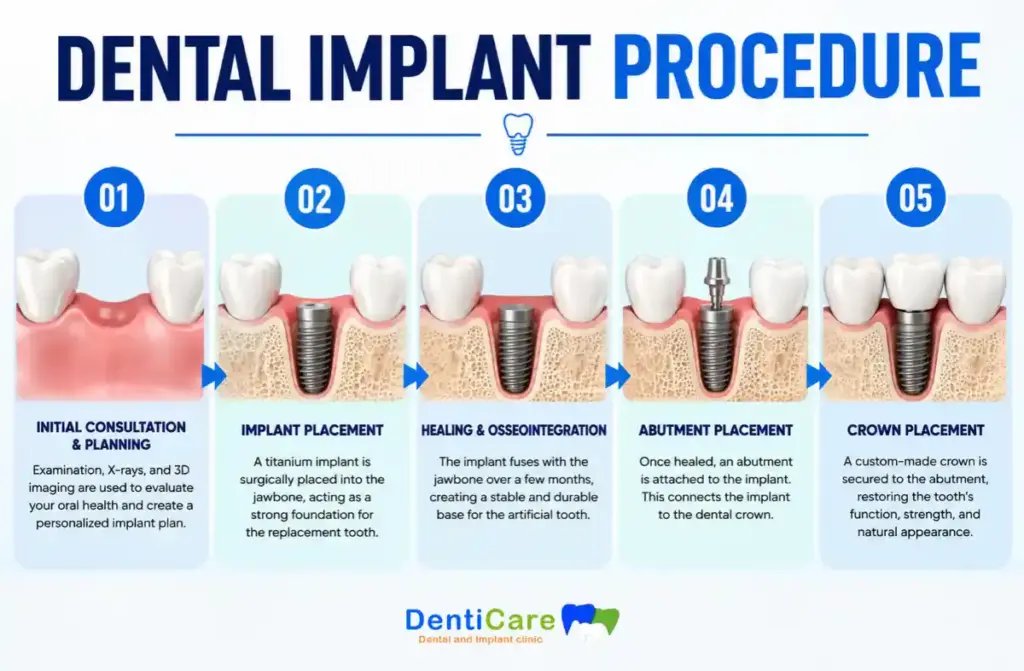
Getting dental implants in Anna Nagar at Denticare usually follows five steps.
Step 1: Consultation and CBCT Scan
Your first visit is about understanding your needs. Dr. Gnanaraj Jayabal examines your mouth, checks your gums and bite, and reviews your medical history and medicines. A CBCT scan, which is a 3D X ray of your jaw, shows the height and width of your bone and the position of nerves and sinuses.
You will then receive a written treatment plan. It covers the number of implants, the type of implant, any extra treatment needed, the expected timeline and the full cost. You are free to take time, ask questions and decide when you are ready.
Step 2: Implant Placement
The area is numbed with local anaesthesia, so you stay awake but should not feel pain. The dentist makes a small opening in the gum, prepares a space in the bone and places the implant. A few stitches may be used to close the gum.
Placing one implant usually takes about 30 to 60 minutes. It is done as an outpatient procedure, and most patients go home the same day.
Step 3: Healing
Over the next few months, the bone bonds with the implant. This usually takes about 3 to 6 months, depending on your bone and whether grafting was done. A temporary tooth may be given in some cases so you do not have a visible gap.
Step 4: Abutment Fitting
Once the implant is firm, a small abutment is attached to it. This piece connects the implant to the final crown. Impressions or digital scans of your teeth are taken at this stage.
Step 5: Crown Placement
A custom crown is made to match the shape, size and shade of your natural teeth. It is fixed onto the abutment, and your bite is checked and adjusted for comfort.
For a single tooth, the whole process usually takes about 3 to 6 months from start to finish.
Advanced Implant Treatments at Denticare
Some patients need more than a single implant. Depending on your case, your treatment plan may include:
CBCT Guided Planning and Guided Surgery
The 3D scan is used to plan the exact position, angle and depth of each implant. In suitable cases, a surgical guide made from this plan helps place the implant precisely.
All on 4 and All on 6
For people who have lost most or all of their teeth in one jaw, a full set of fixed teeth can be supported on four to six implants. These teeth are fixed in place and are not removed at night.
Sinus Lift
The upper back teeth sit close to the sinus, an air space above the jaw. If the bone here is thin, a sinus lift gently raises the sinus floor and adds bone underneath to make room for implants.
Bone Grafting
When bone has shrunk after tooth loss, a graft can rebuild the area so it can hold an implant. The graft slowly turns into your own bone over a few months.
Zirconia Implants
For patients who prefer to avoid metal, white zirconia implants are available for selected cases. Your dentist will tell you whether this option fits your mouth.
Failed Implant Management
If an implant placed earlier has become loose, painful or infected, it can be assessed. Depending on the cause, it may be treated, or removed and replaced after healing.
What Affects the Cost of Dental Implants in Anna Nagar?
The cost of dental implants in Anna Nagar differs from patient to patient, because every mouth is different. The main factors are:
- Number of implants: a single tooth costs less than several teeth or a full arch.
- Implant brand and type: different implant systems and materials are priced differently.
- Extra procedures: bone grafting, a sinus lift or tooth removal add to the cost.
- Planning and imaging: CBCT scans and surgical guides are part of careful planning.
- Type of crown or bridge: the material and design of the teeth on top affect the price.
We do not quote a fixed price without examining you and reviewing your scan. After your consultation, you will receive a written, itemised estimate so you know the full amount before treatment starts. You can also ask our team about payment options.
Questions to Ask at Your Implant Consultation
Asking the right questions helps you feel confident in your treatment plan. Here are some useful ones:
- What training does the dentist have in implant treatment?
- Is a CBCT scan used to plan my implant?
- Which implant brand will be used, and why?
- Will I need bone grafting or a sinus lift?
- What does the quoted price include, and what is extra?
- How long will the whole treatment take?
- What happens if there is a problem after treatment?
- What sterilisation steps does the clinic follow?
A good clinic will answer these clearly and give you time to decide.
Recovery After Implant Surgery
Most people find recovery easier than they expect. Some soreness, swelling and slight bruising for a few days is normal.
The First 48 Hours
- Eat soft, cool foods such as curd rice, idli and soups
- Avoid hot drinks and very spicy food
- Do not rinse forcefully or spit hard
- Hold an ice pack on the cheek for short periods to reduce swelling
- Take your medicines exactly as advised
The Following Weeks
- Brush gently around the area
- Use an antimicrobial mouth rinse if your dentist advises it
- Avoid smoking, as it slows healing
- Attend all follow up visits
Warning Signs
Contact the clinic if you notice:
- Pain that keeps getting worse after the first few days
- Swelling that keeps increasing
- A loose feeling in the implant
- Pus, a bad taste or fever
Caring for Your Implant Long Term
An implant cannot get tooth decay, but the gum and bone around it can still become infected. Good daily care keeps your implant healthy for years.
- Brush twice a day with a soft brush
- Clean between teeth and around the implant with floss or an interdental brush
- Visit the clinic for check ups and professional cleaning every six months
- Avoid biting very hard foods or objects such as ice and bottle caps
- Wear a night guard if you grind your teeth
How Long Do Dental Implants Last?
With good home care and regular check ups, implants can last for many years, and many last for decades. The crown on top faces daily chewing, so it may need to be replaced at some point because of normal wear. How long your implant lasts depends on your gum health, cleaning habits, smoking, grinding and general health.
About Dr. Gnanaraj Jayabal
Dr. Gnanaraj Jayabal is the principal dentist and founder of Denticare Dental & Implant Clinic. He personally plans and places every implant at the clinic.
- Principal Dentist and Founder, Denticare Dental & Implant Clinic, Mogappair, Chennai
- BDS, Government Dental College (MMC), Chennai
- Post Graduate Diploma in Clinical Dentistry, University of Melbourne
- ASID Certified, Australian Society of Implant Dentistry (all three levels of accreditation)
- Advanced training in zygoma implant surgery
- Over 20 years of clinical experience in dentistry
How We Care for Implant Patients
- One treating dentist: the same dentist sees you from your first consultation to your final crown.
- CBCT guided planning: every implant is planned using a 3D scan of your jaw.
- Strict sterilisation: all instruments are cleaned and sterilised following set protocols.
- Clear information: your options, risks, timeline and costs are explained before you agree to treatment.
- Follow up care: regular review visits help keep your implant and gums healthy.
Book a Consultation
If you are looking for dental implants in Anna Nagar, Denticare in Mogappair is a short drive away. Patients from Anna Nagar, Anna Nagar West, Mogappair, Ambattur and nearby areas visit us for implant care.
- Call +91 98411 00500
- Book an appointment online through our website
- Message us on WhatsApp
- Email denticare.dentists@gmail.com
Please bring any recent dental X rays, scans and a list of your current medicines to your first visit.
Final Thoughts
Replacing a missing tooth is an important decision, and it helps to take it step by step. Dental implants in Anna Nagar can give you a fixed, natural looking tooth that lets you eat, speak and smile with comfort. The right choice depends on your bone, gums, general health and budget. A careful consultation, a written plan and clear answers to your questions will help you choose what feels right for you.